Our Domaines Barons de Rothschild case's Appendix A note on Russia as an emerging area of consumption caught my interest. The case states: "One commonality in areas of growing consumption was the association of wine with status."
As of 2017, wine is a nearly $700M market in Russia. I'm curious as to how wine evolved alongside culture and status in Russia's storied history. As a literary enthusiast, I thought a prime lens through which to analyze this topic was literature, and where better start than Tolstoy's Anna Karenina, published in 1877, a crown jewel of Russian -- and world -- literature. (Also definitely not coincidentally one of my most beloved classics).
Anna Karenina depicts the downfall of Karenina, a countess in Imperial Russia, as she delves into an extramarital affair that challenges the boundaries of high Russian society and ultimately leads to her suicide. One of the most famous passages in Anna Karenina evokes wine's intersection with both high class in Russia and romantic enchantment.
Upon meeting the man with whom she will eventually have an affair, "Anna was drunk with the wine of the rapture she inspired... the tremulous, flashing light in her eyes, the smile of happiness and excitement that involuntarily curved her lips, and the precise gracefulness, assurance, and lightness of her movements... 'No, it's not the admiration of the crowd she's drunk with, but the rapture of one man'" (Tolstoy 176).
Tolstoy wields wine as an immensely powerful metaphor in this timeless excerpt. At the high society event where Anna meets her lover, she is drink with wine and the rapture of her extramarital suitor. Here, Tolstoy strikes an unflinching parallel between wine and raw romanticism.
There is something fearlessly tangible about this connection between wine and desire, suggestive of a greater historical high Russian societal association of wine with pleasure, status, and privilege.

Monday, January 21, 2019

Can We Stop Worrying About Sulfites?
As someone who spends way too much time scrolling through the feeds of Instagram wellness bloggers, has more than one friend who rotates between the trendiest elimination diets, and who adopts a fringe diet herself, I've come across a fair share of people avoiding sulfites. This left me to wonder, what are sulfites and should I actually be worried about them?
Sulfites (sulphur dioxide, SO2, a compound made up of sulfur and oxygen) are a naturally-occurring compound found in wine. In addition to being naturally occurring, sulfites are produced in labs and added as a preservative in many foods. Winemakers use sulfites in this way; sulfites preserve the flavor of a wine, allowing it to age without turning to vinegar.
Sulfites are naturally created during fermentation, so even wines labeled as "sulfite-free" have sulfites. Any bottle of wine containing more than 10 parts per million (ppm) of SO2 must be affixed with a "contains sulfites" label, so you can effectively consider the "sulfite-free" label to mean "no added sulfites." In the United States the legal limit for sulfites is 350 ppm, with most wines ranging between 30-120 ppm. The maximum for US organic certified wines is 100 ppm.
Sulfites are anecdotally accused of causing headaches, but there haven't been scientific studies that back this up. One 2014 study did not find a decreased prevalence of headaches in those who drank organic low-sulfite wines when compared to those who drank traditional wines. If you get a headache from wine, it most likely has to do with dehydration or the quantity of wine consumed, not the sulfite content.
Lastly, the level of sulfites in other common foods far exceeds those in wine. Dried fruits sometimes reach sulfite levels of over 1,000 ppm. Other foods with higher sulfite content include chips, french fries, and pickles.
If you're really worried about sulfites, instead of buying an $80 sulfite remover, just choose a chocolate chip cookie over an oatmeal raisin one.
Sources:
https://www.bonappetit.com/drinks/wine/article/sulfite-free-wine
https://www.scientificamerican.com/article/myths-about-sulfites-and-wine/
https://www.wired.com/2015/06/wine-sulfites-fine-heres-remove-anyway/
https://www.decanter.com/learn/wine-terminology/sulfites-in-wine-friend-or-foe-295931/
https://www.thekitchn.com/the-truth-about-sulfites-in-wine-myths-of-red-wine-headaches-100878
https://www.shape.com/healthy-eating/healthy-drinks/are-sulfites-wine-bad-your-health
Sulfites (sulphur dioxide, SO2, a compound made up of sulfur and oxygen) are a naturally-occurring compound found in wine. In addition to being naturally occurring, sulfites are produced in labs and added as a preservative in many foods. Winemakers use sulfites in this way; sulfites preserve the flavor of a wine, allowing it to age without turning to vinegar.
Sulfites are naturally created during fermentation, so even wines labeled as "sulfite-free" have sulfites. Any bottle of wine containing more than 10 parts per million (ppm) of SO2 must be affixed with a "contains sulfites" label, so you can effectively consider the "sulfite-free" label to mean "no added sulfites." In the United States the legal limit for sulfites is 350 ppm, with most wines ranging between 30-120 ppm. The maximum for US organic certified wines is 100 ppm.
Sulfites are anecdotally accused of causing headaches, but there haven't been scientific studies that back this up. One 2014 study did not find a decreased prevalence of headaches in those who drank organic low-sulfite wines when compared to those who drank traditional wines. If you get a headache from wine, it most likely has to do with dehydration or the quantity of wine consumed, not the sulfite content.
Lastly, the level of sulfites in other common foods far exceeds those in wine. Dried fruits sometimes reach sulfite levels of over 1,000 ppm. Other foods with higher sulfite content include chips, french fries, and pickles.
If you're really worried about sulfites, instead of buying an $80 sulfite remover, just choose a chocolate chip cookie over an oatmeal raisin one.
Sources:
https://www.bonappetit.com/drinks/wine/article/sulfite-free-wine
https://www.scientificamerican.com/article/myths-about-sulfites-and-wine/
https://www.wired.com/2015/06/wine-sulfites-fine-heres-remove-anyway/
https://www.decanter.com/learn/wine-terminology/sulfites-in-wine-friend-or-foe-295931/
https://www.thekitchn.com/the-truth-about-sulfites-in-wine-myths-of-red-wine-headaches-100878
https://www.shape.com/healthy-eating/healthy-drinks/are-sulfites-wine-bad-your-health
Sunday, January 20, 2019
Those evil tied houses
All last week's discussion of "tied houses" laws left my head spinning, so I decided to do some further research.
The original tied houses were pubs that were contracted with (or owned by) specific breweries to sell only that brewery's beer. The brewery got a steady source of demand, the pub got favorable pricing or exclusive sales rights, and everyone was happy.
Well, not everyone. Tied houses were a villain to temperance campaigners. Pubs tied to breweries were fiercely competitive. (After all, it was doubly important to sell the beer -- it mattered to both the pub business and the brewery business!) The results were aggressive marketing tactics: low beer prices, offers of free lunch with drinks, and salty bar snacks, all things that encourage more drinking. Temperance leaders blamed alcohol consumption for crime and low living standards -- and tied houses were scourges that encouraged intoxication. (Adopting the second part of this narrative, many histories of tied house law partially blame the tied house system for Prohibition. If not for excessive drinking in tied houses, the logic goes, public outrage over alcohol wouldn't have been sufficient to justify the Eighteenth Amendment.)
When Prohibition was repealed after a disastrous thirteen years, states were given the responsibility of writing and enforcing their own liquor laws. Each created some form of a three-tier system with tied-house prohibitions.
From brewery-owned pubs where people got too drunk to wineries getting in trouble for tweets seems like a stretch, but there you go! California tied house laws were upheld in court as recently as 2017, and some people think these laws are still an essential part of encouraging temperance. It will be interesting to follow the legal developments: as tied house laws vs. First Amendment cases crop up around the country, this issue may end up in the Supreme Court.
The original tied houses were pubs that were contracted with (or owned by) specific breweries to sell only that brewery's beer. The brewery got a steady source of demand, the pub got favorable pricing or exclusive sales rights, and everyone was happy.
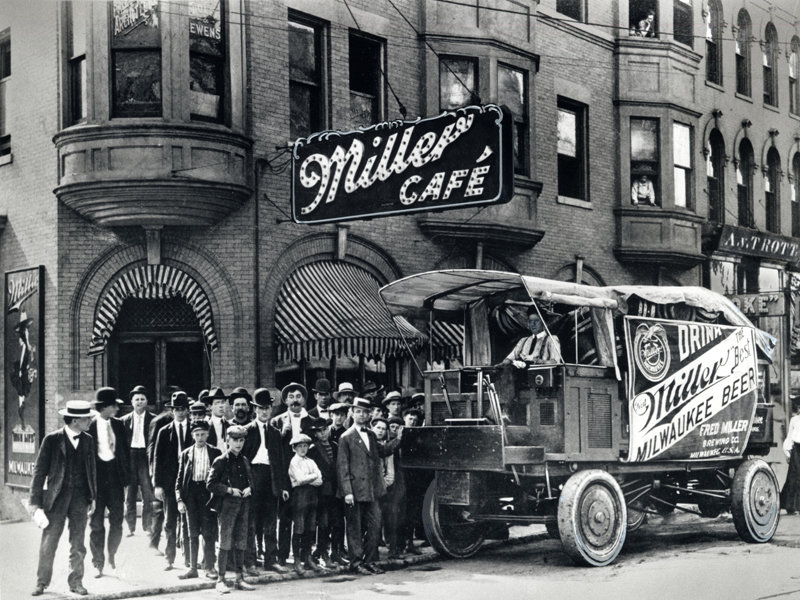 |
| Miller Cafe in Milwaukee (Photo: MillerCoors, via https://onmilwaukee.com/bars/articles/miller-tied-houses.html) |
Well, not everyone. Tied houses were a villain to temperance campaigners. Pubs tied to breweries were fiercely competitive. (After all, it was doubly important to sell the beer -- it mattered to both the pub business and the brewery business!) The results were aggressive marketing tactics: low beer prices, offers of free lunch with drinks, and salty bar snacks, all things that encourage more drinking. Temperance leaders blamed alcohol consumption for crime and low living standards -- and tied houses were scourges that encouraged intoxication. (Adopting the second part of this narrative, many histories of tied house law partially blame the tied house system for Prohibition. If not for excessive drinking in tied houses, the logic goes, public outrage over alcohol wouldn't have been sufficient to justify the Eighteenth Amendment.)
When Prohibition was repealed after a disastrous thirteen years, states were given the responsibility of writing and enforcing their own liquor laws. Each created some form of a three-tier system with tied-house prohibitions.
From brewery-owned pubs where people got too drunk to wineries getting in trouble for tweets seems like a stretch, but there you go! California tied house laws were upheld in court as recently as 2017, and some people think these laws are still an essential part of encouraging temperance. It will be interesting to follow the legal developments: as tied house laws vs. First Amendment cases crop up around the country, this issue may end up in the Supreme Court.
Follow up on Regulation Lecture - Mobile Alcohol Delivery Platform
Came
across this interesting article on how Eaze (cannabis) and Drizzly (alcohol)
mobile delivery platforms navigated through the stringent regulation and
achieved relative success so far. Key takeaways are below and more
details can be found in this link: https://jilt.com/upsell/drizly-eaze-regulations/
·
Know
market regulations inside and out
·
Focus
on customer experience
·
Work
with knowledgeable partners (In Drizzly's case, Wine & Spirits
Wholesalers of America, an established distributor and also an early investor
in the business has helped the business work with the regulators and expand
nationally)
·
Build
compliant technologies (including ID check, payment)
·
Make
data-driven decisions
Sparkling Reds...
At a restaurant with friends recently, I was introduced to a type of wine I literally would have thought was made up....except it was on the menu: sparkling reds.
The experience had me reflecting on various types of wine and wondering where the boundary was. Why did I find the idea of a sparkling red so offensive and what does this mean about our social taste in wine? The fact that I enjoy sparkling whites a lot meant that a sparkling red shouldn't really be such a crazy concept. The distinction felt as arbitrary as the fact that certain types of meats are eaten in one culture, while other individuals in another region would turn their noses up at it.
For anyone else who's wondering - sparkling reds is a small but growing category! There is some interesting background reading here in this article: https://www.eater.com/wine/2016/8/30/12694650/lambrusco-best-sparkling-wine
Food and Wine magazine has also highlighted four sparkling reds to try in this article: https://www.foodandwine.com/blogs/4-great-sparkling-red-wines
Cheers to expanding our opinions into what is an acceptable wine category!
The experience had me reflecting on various types of wine and wondering where the boundary was. Why did I find the idea of a sparkling red so offensive and what does this mean about our social taste in wine? The fact that I enjoy sparkling whites a lot meant that a sparkling red shouldn't really be such a crazy concept. The distinction felt as arbitrary as the fact that certain types of meats are eaten in one culture, while other individuals in another region would turn their noses up at it.
For anyone else who's wondering - sparkling reds is a small but growing category! There is some interesting background reading here in this article: https://www.eater.com/wine/2016/8/30/12694650/lambrusco-best-sparkling-wine
Food and Wine magazine has also highlighted four sparkling reds to try in this article: https://www.foodandwine.com/blogs/4-great-sparkling-red-wines
Cheers to expanding our opinions into what is an acceptable wine category!
Thursday, January 17, 2019
Why wine?
Wine has a way of weaving itself in and out of life. These days, I frequently share wine with friends, order wine while out for dinner, and visit wineries and tasting rooms when family comes to visit. Many of my favorite memories and traditions stem from experiences with wine, and I notice I spend more on wine as my tastes mature. I am taking a class on the dynamics of the wine industry because I feel wine will have a lasting place in my life; I am eager to further my knowledge of the wine industry and hope to share this knowledge to elevate the wine-drinking experience of others.
In the shorter term, this class will dovetail with a wine venture with my classmate and business partner are pursuing through Startup Garage. Our company, Cab Labs, was born when Sarah took the Dynamics of the Wine Industry last year and approached me with an idea to bring a modern voice and new brand to wine. Since last Spring, Sarah and I have spoken to more than 50 wineries and winemakers and countless wine consumers to refine our business plan. As a result, I have become enthralled by the wine industry, particularly the complexity and opacity of the wine supply chain. I am excited to continue learning through this course and am especially interested in innovations that might change how consumers experience wine differently in the future.
In the shorter term, this class will dovetail with a wine venture with my classmate and business partner are pursuing through Startup Garage. Our company, Cab Labs, was born when Sarah took the Dynamics of the Wine Industry last year and approached me with an idea to bring a modern voice and new brand to wine. Since last Spring, Sarah and I have spoken to more than 50 wineries and winemakers and countless wine consumers to refine our business plan. As a result, I have become enthralled by the wine industry, particularly the complexity and opacity of the wine supply chain. I am excited to continue learning through this course and am especially interested in innovations that might change how consumers experience wine differently in the future.
Why I'm taking this class
When I think wine, I think of happy moments. I only really started drinking wine during my undergraduate at university. Ever since, wine has coincided with happy memories in my life. I did study abroad in my final year of my undergrad near Paris, which involved a lot of wine drinking. Subsequently, I started my consulting career, which involved many dinners and gatherings at seniors' homes. Seniors were very happy to share their knowledge and collection of wine. Earning an income also meant being able to travel to Australia's wine regions during weekends. I visited the Hunter Valley during 25th birthdays and the Barossa Valley to celebrate anniversaries and a colleague's 40th birthday. These tours made me appreciate the complexities of wine and the wine business, which operates at the intersection of art, agriculture/nature, science and business. The industry fascinates me and I hope to learn more about the global wine industry through this class, out of both interest and potential future investments in the sector.
Subscribe to:
Posts (Atom)